
How Ergonomics Became a Clinical Outcomes Issue. And What That Means for Cart Design
By First Products on Sep 29th 2026
Mobile cart ergonomics and patient safety belong in the same purchasing conversation. Cart design affects how clinicians move, reach, document, and use technology throughout a shift. That makes ergonomics worth evaluating with the same care as other healthcare technology requirements.
Healthcare IT teams rigorously evaluate system integration, cybersecurity, and deployment requirements. Yet ergonomics is sometimes reduced to a checkbox. A mobile workstation can meet technical specifications and still be difficult for the people expected to use it every day.
If clinicians must repeatedly hunch, reach, or push an unwieldy cart, its design becomes more than a comfort issue.
That does not mean a poorly designed cart can be blamed for a particular patient outcome. It does mean healthcare leaders should examine whether their equipment adds avoidable physical demands and workflow friction. Understanding how ergonomics is measured across a healthcare facility is a useful starting point.
What the Research Tells Us About Ergonomics, Fatigue, and Patient Safety
Healthcare work is physically demanding. According to the U.S. Bureau of Labor Statistics' 2024 industry injury and illness data, hospitals recorded 5.1 total recordable workplace injury and illness cases per 100 full-time equivalent workers.
The healthcare and social assistance sector recorded 3.4 cases, compared with 2.3 across private industry overall. These figures describe all recordable cases, not injuries attributable to medical carts.
The National Institute for Occupational Safety and Health (NIOSH) identifies forceful exertion, repetition, and awkward postures among the risk factors associated with work-related musculoskeletal disorders.
Cart selection cannot eliminate all these risks, especially those related to patient handling. However, workstation height, maneuverability, reach, and equipment placement are design variables a facility can evaluate.
Fatigue also warrants attention. A systematic review of 22 studies on hospital nurse fatigue found consistent associations with decreased nursing performance and sickness absence, along with negative patient-safety and organizational outcomes.
Separately, a scoping review of 38 studies reported that 82% of included studies identified fatigue as a contributing factor in medication administration errors or near misses, although fatigue measures varied considerably.
These studies do not establish that cart design causes medication errors or that a particular cart prevents them. They do show why reducing avoidable physical demands and assessing equipment usability are worthwhile parts of a broader workforce and patient-safety strategy.
Where Mobile Medical Cart Design Breaks Down
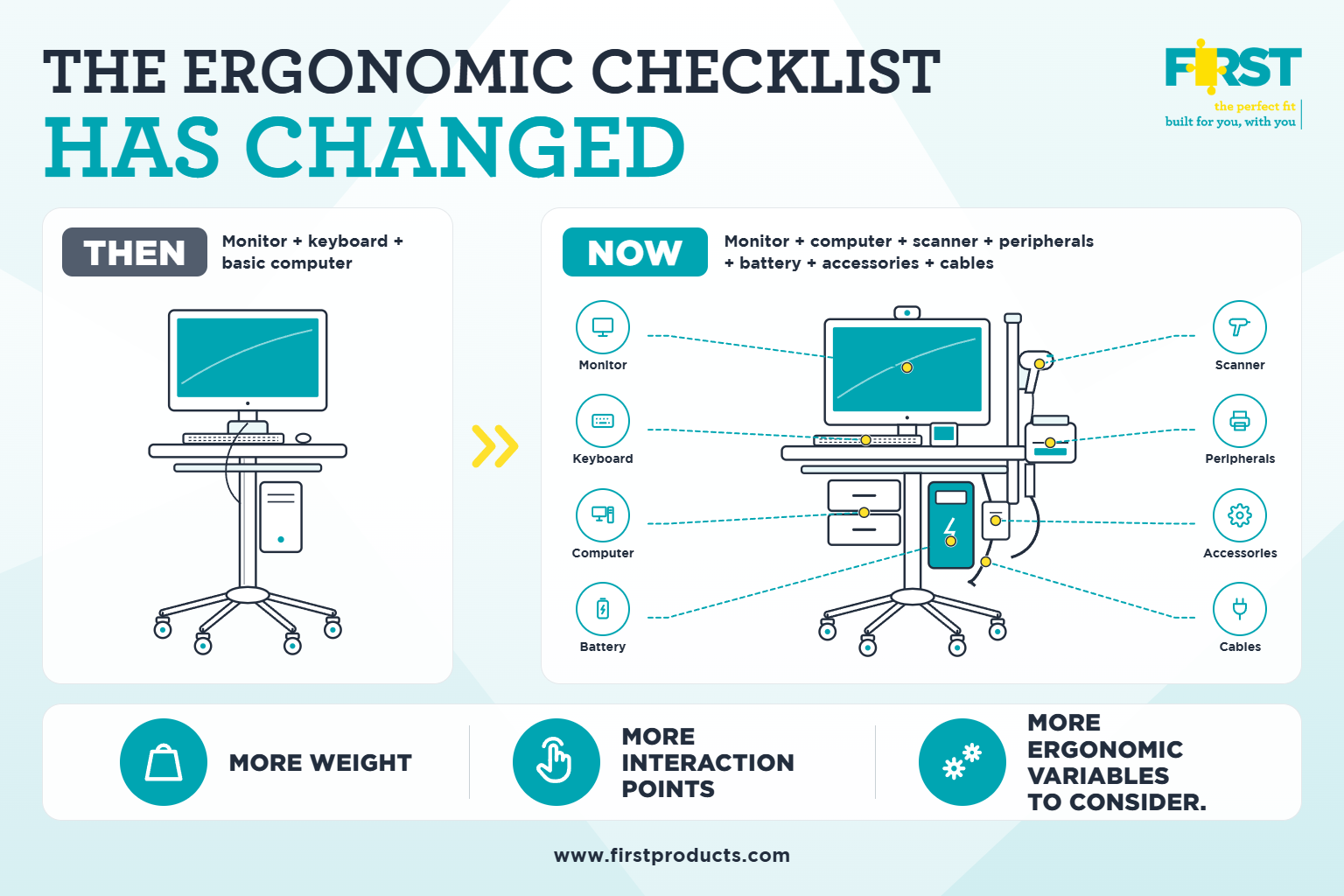
Today's mobile workstations may carry displays, computers, scanners, batteries, printers, and other peripherals. Every added device can change the way a cart moves and how clinicians interact with it.
The specific ergonomic factors that matter in cart design therefore need to be evaluated with the intended equipment installed.
Height and Reach
Fixed-height or insufficiently adjustable work surfaces can require repeated bending, elevated shoulders, or awkward wrist positions. Clinicians of different heights should be able to perform common tasks comfortably.
Loaded Weight and Maneuverability
A cart that moves easily when empty may behave differently after batteries, computers, and accessories are added. Evaluate pushing, turning, stopping, and navigating the actual clinical space using the proposed configuration.
Cable Management and Changing Technology
Unmanaged cables and poorly positioned accessories can create snag points, interfere with adjustments, or require unnecessary reaching.
As technology changes, the original ergonomic assumptions may no longer hold.
What Clinician-Informed Cart Design Looks Like
Evaluating a product specification sheet is important, but it cannot fully describe how a workstation will perform during a real shift.
A more useful starting question is: What does this solution need to do for the people using it?
First Products approaches that question through its FirstFit™ Framework .
During the Discover phase, teams examine workflows, environments, and technology requirements.
Through CODESIGNLIVE™ sessions, clinicians, IT stakeholders, and First Products engineers collaborate on the proposed solution before design is finalized.
Prototypes and pilot testing create opportunities to assess how the cart works in practice before wider deployment.
This process brings the people who understand the work into decisions about equipment placement, reach, movement, and usability.
The aim is a tailored, configurable solution that reflects the interaction among the clinician, technology, cart, and clinical environment.
Learn more about the link between ergonomic equipment and staff burnout and browse First Products' mobile cart and mount solutions .
What to Ask a Medical Cart Vendor Before You Buy
Healthcare leaders already expect evidence when reviewing integration, security, and capital investment. Apply a similarly structured approach to hospital cart ergonomics.
Ask prospective vendors:
- What does "ergonomic" mean in your design and evaluation process?
- What height and reach ranges can the proposed configuration accommodate?
- How does the cart perform with our actual equipment, accessories, batteries, and total loaded weight?
- How are cable management, balance, maneuverability, and space constraints evaluated?
- When do clinicians participate in the design and testing process?
- Can we test a prototype with representative users before deployment?
- How will feedback be captured if workflows or technology requirements change?
Document the answers and involve the clinicians who will use the carts.
This creates more useful purchasing criteria than accepting an unqualified claim that a workstation is ergonomic.
Change the Conversation Before Deployment
Cart ergonomics should not be treated as a one-time product feature. It is the relationship between the equipment, its users, the technology it supports, and the work being performed.
Evaluating that relationship can help organizations identify avoidable physical demands and usability issues before rollout.
It is one practical part of a wider effort to support clinicians and safer care.
Explore the FirstFit Framework >
Frequently Asked Questions About Mobile Cart Ergonomics
How does cart ergonomics affect patient safety, not just staff comfort?
Cart ergonomics can affect the physical demands and usability of bedside workstations. Awkward reaching, difficult maneuvering, or poorly placed devices may add friction to clinical workflows.
Research connects nurse fatigue with adverse performance and patient-safety outcomes, but direct evidence linking particular cart designs to patient outcomes is limited. Ergonomic evaluation is one component of a broader safety strategy.
What ergonomic features matter most in a mobile medical cart?
Evaluate adjustable work-surface height, comfortable reach to frequently used devices, maneuverability at the actual loaded weight, cable management, and a footprint suited to the clinical environment.
The most relevant features depend on who will use the cart, the technology it carries, and the tasks performed. Test a representative configuration with clinicians rather than relying only on specifications.
How common are musculoskeletal injuries among healthcare workers?
Healthcare is a physically demanding sector. In 2024, hospitals reported 5.1 total recordable injury and illness cases per 100 full-time equivalent workers, compared with 2.3 across private industry, according to the U.S. Bureau of Labor Statistics.
These figures include many kinds of workplace cases and do not isolate musculoskeletal injuries or medical-cart-related injuries.
Can equipment design really influence clinical outcomes?
Equipment design can influence how easily clinicians complete tasks, access technology, and move through care environments.
Research links fatigue with nursing performance and patient-safety outcomes, providing a reason to reduce unnecessary physical demands.
However, studies on fatigue do not by themselves prove that changing a medical cart improves a specific clinical outcome. Local usability testing and post-deployment feedback remain important.
How does First Products approach cart ergonomics?
Through the FirstFit Framework, First Products begins with the facility's workflows and technology requirements.
Its CODESIGNLIVE sessions bring clinicians, IT stakeholders, and engineers into the design process before a cart is finalized.
Prototype and pilot testing provide opportunities to evaluate how a tailored configuration works in the intended clinical setting and refine it before broader deployment.
Research and Further Reading