
7 Strategies for Preventing Nurse Burnout
By First Products on Jul 28th 2022
Originally published July 28, 2022 | Updated August 17, 2026
Nurse burnout is not a new challenge, but it continues to be one of the most important workforce issues facing healthcare organizations.
Long hours, staffing pressures, emotionally demanding work, administrative burden, workplace violence, and inefficient workflows can all contribute to chronic workplace stress for nurses and other frontline healthcare professionals.
For hospitals, clinics, long-term care facilities, and other healthcare organizations, addressing burnout is not simply a matter of employee morale. It can influence retention, staffing stability, patient safety, and the overall effectiveness of the clinical environment.
In This Article
- What is nurse burnout?
- What causes nurse burnout and fatigue?
- Why nurse burnout matters
- 7 strategies for helping prevent nurse burnout
- How ergonomics can support nursing workflows
- Questions healthcare leaders can ask
- Frequently asked questions
What Is Nurse Burnout?
Nurse burnout is commonly associated with prolonged workplace stress that has not been successfully managed. It may involve emotional exhaustion, disengagement, reduced professional satisfaction, and a growing sense of detachment from work.
The American Nurses Association identifies burnout as an important workplace issue for nurses, whose jobs often combine physical demands, emotional strain, and high-stakes decision-making.
Warning signs may include:
- Persistent physical or emotional exhaustion
- Reduced engagement with work
- Difficulty recovering between shifts
- Increasing frustration or cynicism
- Lower job satisfaction
- A feeling of being unable to keep up with workload demands
The U.S. Bureau of Labor Statistics projects continued demand for registered nurses, making retention and healthy working environments increasingly important for healthcare organizations.
What Causes Nurse Burnout and Fatigue?
There is rarely one single cause of nurse burnout. Instead, it often develops from a combination of ongoing workplace pressures.
Long Hours and Heavy Workloads
Extended shifts, overtime, staffing shortages, and high patient loads can make it difficult for nurses to recover physically and mentally between workdays.
Insufficient Rest and Recovery
Irregular schedules, consecutive shifts, overnight work, and meetings scheduled outside normal working hours can interfere with adequate rest.
High-Stress Clinical Environments
Nurses working in emergency departments, intensive care, oncology, critical care, behavioral health, and other high-acuity settings may regularly experience emotionally difficult situations and rapid decision-making.
Staffing and Workload Imbalances
Inadequate staffing can increase workload for the nurses who are present.
The Agency for Healthcare Research and Quality has examined the relationship between nursing workforce challenges, working conditions, missed care, and patient safety.
Lack of Support or Input
Poor communication, limited teamwork, workplace conflict, lack of leadership support, and policies created without frontline input can contribute to frustration and disengagement.
Inefficient Workflows and Equipment
Burnout is often discussed in terms of emotional stress, but physical and operational friction also matters.
Repeatedly walking back to a nursing station, searching for supplies, bending or reaching to use poorly positioned equipment, dealing with tangled cables, or documenting at a workstation that does not fit the user can add unnecessary effort throughout a shift.
Why Nurse Burnout Matters to Healthcare Organizations
Burnout affects more than the individual employee.
Healthcare organizations may experience:
- Higher turnover: Burnout can contribute to nurses leaving a position or organization.
- Staffing instability: Turnover can increase pressure on remaining staff.
- Lower engagement: Exhausted staff may have less capacity for training and process improvement.
- Patient safety concerns: Heavy workloads and fatigue can affect the care environment.
- Recruiting and onboarding costs: Replacing experienced staff takes organizational time and resources.
7 Strategies for Helping Prevent Nurse Burnout
Burnout is a complex organizational challenge, and there is no single solution. Healthcare leaders can, however, reduce unnecessary stressors and create working environments that better support staff.
1. Build More Sustainable Scheduling Practices
Review consecutive shifts, overtime expectations, time between shifts, frequent schedule changes, and patterns of extended shifts.
The objective is to provide adequate opportunities for physical and mental recovery whenever possible.
2. Respect Off-Shift Time
Very early meetings, late meetings, mandatory training outside scheduled hours, and frequent after-hours communication can interfere with rest.
Whenever possible, meetings and administrative requirements should accommodate the schedules of staff working different shifts.
3. Include Nurses in Workflow and Policy Decisions
Nurses experience clinical processes firsthand.
Before changing documentation procedures, room layouts, equipment, staffing processes, or policies, ask frontline staff where they are experiencing friction.
4. Address Organizational Causes, Not Just Individual Resilience
Wellness programs, peer support, counseling resources, and education can be valuable, but burnout prevention should not rely exclusively on individual nurses becoming more resilient.
The CDC and NIOSH emphasize the importance of addressing workplace conditions that affect healthcare worker wellbeing.
Healthcare organizations should evaluate factors such as:
- Staffing
- Workload
- Administrative burden
- Workplace safety
- Communication
- Access to equipment and supplies
- Workflow efficiency
5. Reduce Unnecessary Workflow Friction
Examine the small tasks nurses repeat throughout a shift.
Are supplies available where they are needed? Does documentation require unnecessary walking? Are staff repeatedly searching for chargers, scanners, medications, or equipment?
Workflow improvements cannot replace adequate staffing, but they can reduce avoidable work.
6. Help Staff Recognize Fatigue and Burnout
Education can help nurses, managers, and administrators identify early signs of chronic stress and fatigue.
Staff should also know what resources are available and how to raise concerns about workload, scheduling, safety, and wellbeing.
7. Use Ergonomically Designed Medical Carts and Equipment
Nursing is physically demanding work. Clinicians may spend hours standing, walking, reaching, pushing equipment, documenting, and moving between patients.
Ergonomically designed medical carts and workstations can help reduce unnecessary physical strain by bringing technology, supplies, and documentation closer to the point of care.
Features worth evaluating include:
- Height-adjustable work surfaces
- Adjustable monitor positioning
- Easy-to-reach keyboards and controls
- Appropriate caster size and maneuverability
- Balanced equipment placement
- Organized cable management
- Accessible storage
- Mobile power
Explore the Mov-it Nurse Assist Mobile Solution
Ergonomics Is One Part of a Bigger Burnout Strategy
Better equipment alone will not solve nurse burnout.
Staffing, scheduling, leadership, workplace culture, psychological safety, and organizational support all play important roles.
But healthcare organizations should not overlook the physical environment.
When nurses repeatedly struggle with equipment that is difficult to move, poorly positioned, or disconnected from the workflow, those frustrations add to an already demanding job.
Ergonomic design can help remove some of that unnecessary friction.
Questions Healthcare Leaders Can Ask
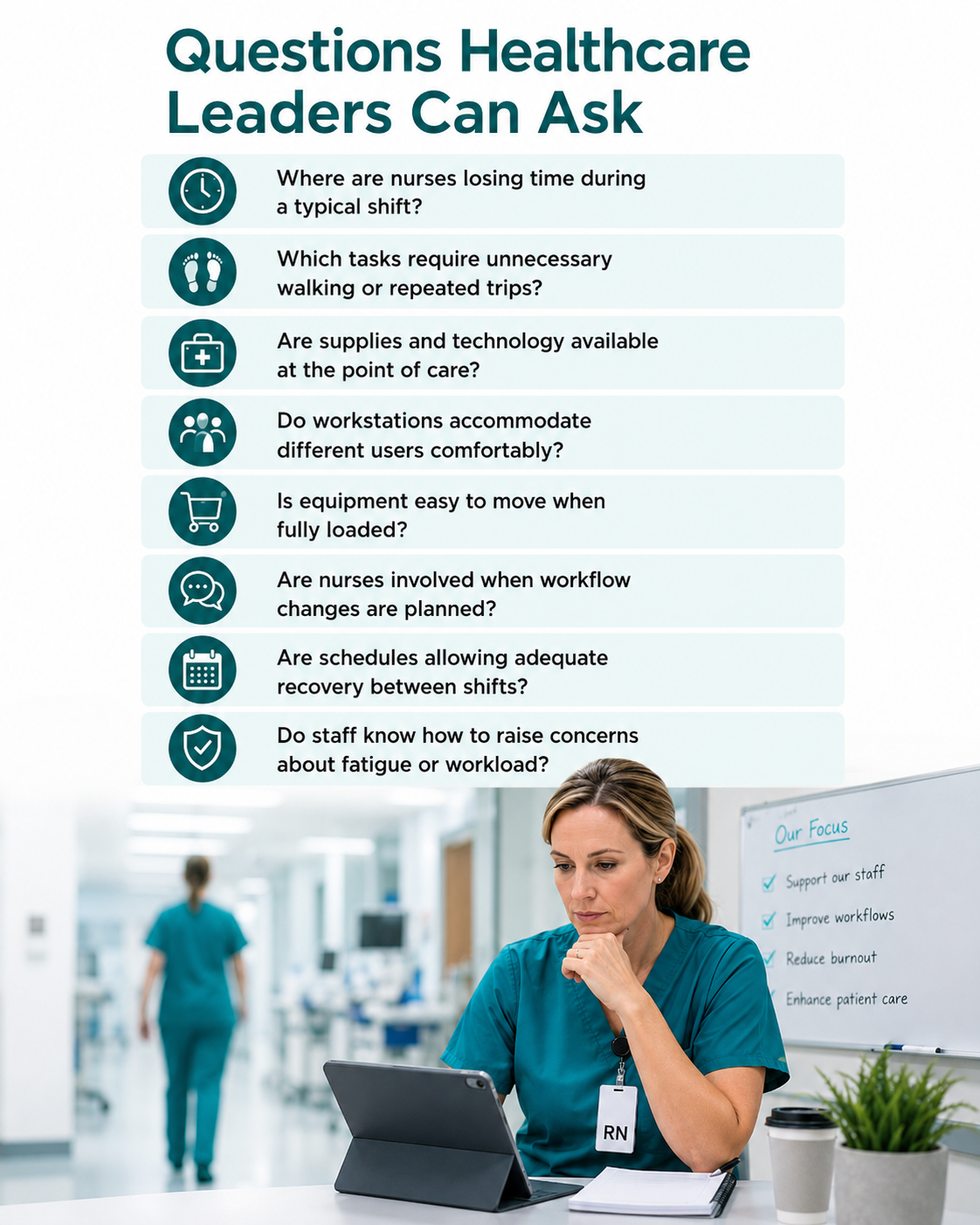
AI model persons are depicted in this image.
- Where are nurses losing time during a typical shift?
- Which tasks require unnecessary walking or repeated trips?
- Are supplies and technology available at the point of care?
- Do workstations accommodate different users comfortably?
- Is equipment easy to move when fully loaded?
- Are nurses involved when workflow changes are planned?
- Are schedules allowing adequate recovery between shifts?
- Do staff know how to raise concerns about fatigue or workload?
First Products: Ergonomic Medical Carts and Workstations
First Products works with healthcare organizations to develop mobile medical carts and workstation solutions around real clinical workflows.
Depending on the application, a solution may incorporate adjustable work surfaces, monitors, laptops, tablets, onboard power, storage, accessories, and other technology used at the point of care.
If a standard configuration does not fit the workflow, First Products can also help develop a specialized solution around the users, devices, and environment.
Learn more about Custom Mobile Medical Carts and Workstations or contact First Products at 1-800-854-8304.
Frequently Asked Questions About Nurse Burnout
What is nurse burnout?
Nurse burnout generally refers to emotional and physical exhaustion associated with prolonged workplace stress. It can involve fatigue, disengagement, reduced job satisfaction, and difficulty recovering from the demands of work.
What are common causes of nurse burnout?
Common contributors may include heavy workloads, long or irregular shifts, inadequate staffing, administrative burden, high-stress clinical environments, workplace conflict, limited organizational support, and inefficient workflows.
How can healthcare organizations help reduce nurse burnout?
Organizations can address burnout by evaluating staffing and workload, creating more sustainable schedules, involving nurses in decisions, improving workplace culture and safety, providing appropriate support resources, and reducing unnecessary workflow and ergonomic burdens.
Can ergonomics help reduce nurse fatigue?
Ergonomically designed equipment can help reduce unnecessary reaching, bending, pushing, and repetitive physical strain. Ergonomics should be viewed as one part of a broader strategy that also addresses staffing, scheduling, leadership, and workplace conditions.
How can mobile medical carts support nursing workflows?
Mobile medical carts can bring computers, displays, supplies, documentation tools, and other technology closer to the point of care. A well-designed cart can help reduce unnecessary walking and keep frequently used tools organized and accessible.