
Why Most Telehealth Cart Rollouts Slip Past 6 Months — and What Made Ours Different
By First Products on Jul 9th 2026
Summary: Why Telehealth Cart Projects Lose Time
- Most telehealth cart deployment delays happen before production begins.
- Late requirements, slow approvals, and scope changes can turn a 3-month project into 6 months or longer.
- Collaborative design reviews help OEMs, IT teams, and clinical stakeholders reduce decision delays.
- First Products’ FirstFit™ Framework helps healthcare organizations move from concept to deployment faster.
Ready to reduce delays in your next custom cart project? Contact First Products to start your perfect-fit solution.
The project is scoped with a budget in place. The manufacturer is selected. Multiple deployment sites are eagerly waiting. One thing that is not happening? Adherence to that tight telehealth cart deployment timeline.
Before the fingers start pointing at manufacturing when custom technology projects stretch months beyond your projected deployment date, consider this: the biggest delays may occur before a single component is fabricated.
Where Telehealth Cart Deployments Actually Lose Time
Original Equipment Manufacturers, or OEMs, probably know this best. When launching a custom laptop cart, mobile workstation, or technology platform, schedules are often built around production lead times. Manufacturing feels like the biggest variable.
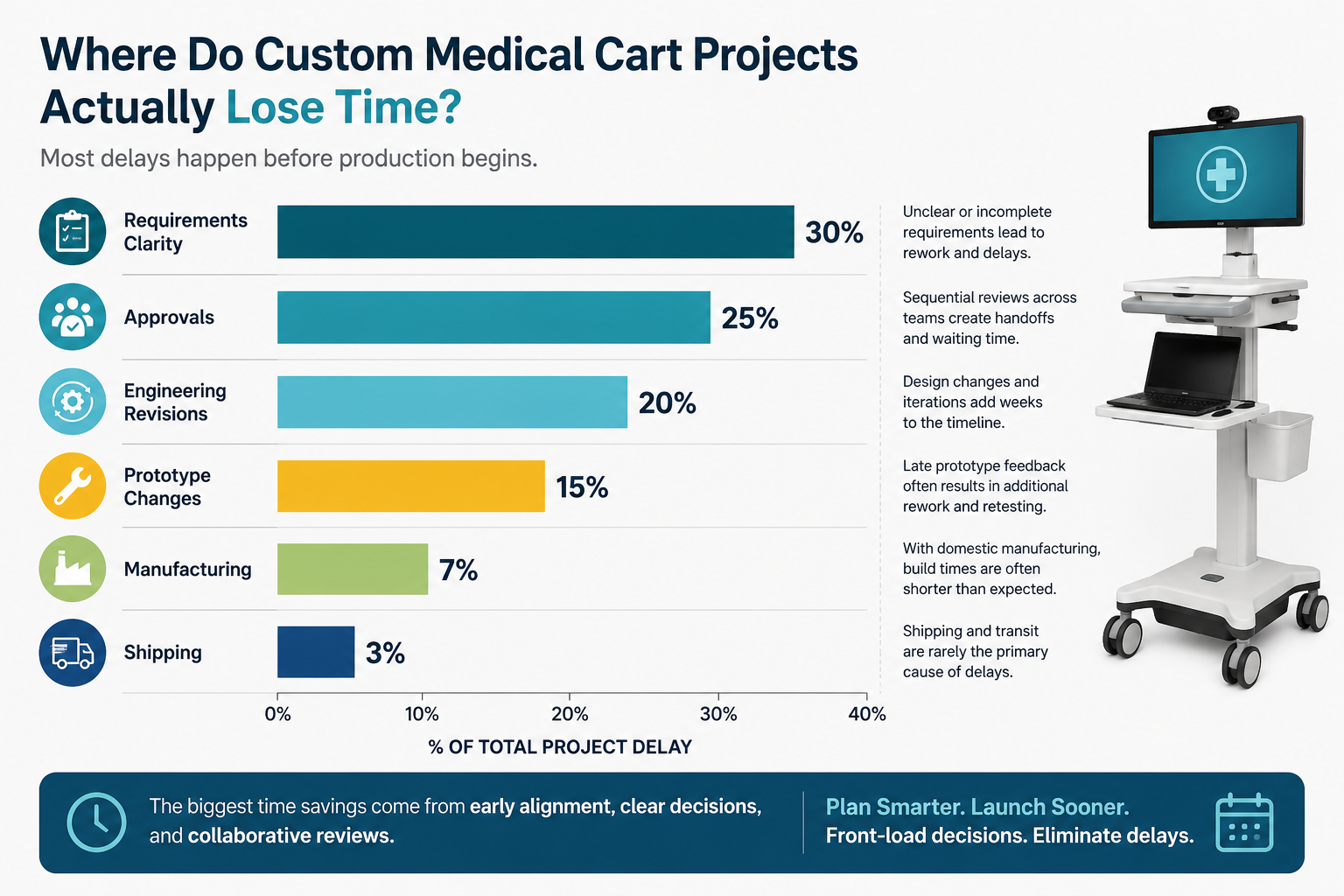
But in many healthcare IT equipment rollouts, the project timeline has already lost weeks or months before production begins.
A typical OEM project for a multi-site medical laptop cart rollout follows a predictable flow: ideation, requirements gathering, engineering review, prototype development, testing, revision, approval, and production release.
The issue is not usually one major delay. It is the compounding effect of small delays:
- Requirements not fully defined: If engineering begins before configuration decisions are finalized, redesign becomes likely.
- Component decisions made too late: Computing devices, displays, power systems, peripherals, docking platforms, and connectivity requirements all affect the final design.
- Sequential stakeholder reviews: Engineering reviews the design, then operations, then IT, then clinical leadership. Each handoff adds time.
- Late-stage scope additions: Requests like adding a scanner mount or supporting a second laptop model can affect engineering, testing, documentation, procurement, and manufacturing.
Why Some OEM Projects Move Faster
Reducing decision time is becoming a competitive advantage for OEMs. Overseas manufacturing and shipping timelines still matter, but domestic manufacturing can help remove some of the uncertainty. The bigger opportunity is often reducing the decision-making bottleneck before production begins.
A traditional process may look like this:
Engineering → Customer Feedback → Revision → Additional Feedback → Revision → Production
A faster collaborative process looks more like this:
Engineering + Operations + IT + End Users working together in real time → Production
Traditional engineering reviews often rely on PDFs, CAD screenshots, emails, and portals. Comments are gathered, consolidated, sent back, revised, and reviewed again. Each handoff introduces delay.
While not every healthcare IT equipment deployment project is on a fast track, replacing long review cycles with live collaboration can reduce stakeholder legwork, strengthen scope control, and help avoid costly redesign cycles.
How FirstFit™ Front-Loads the Decisions That Usually Cause Delays
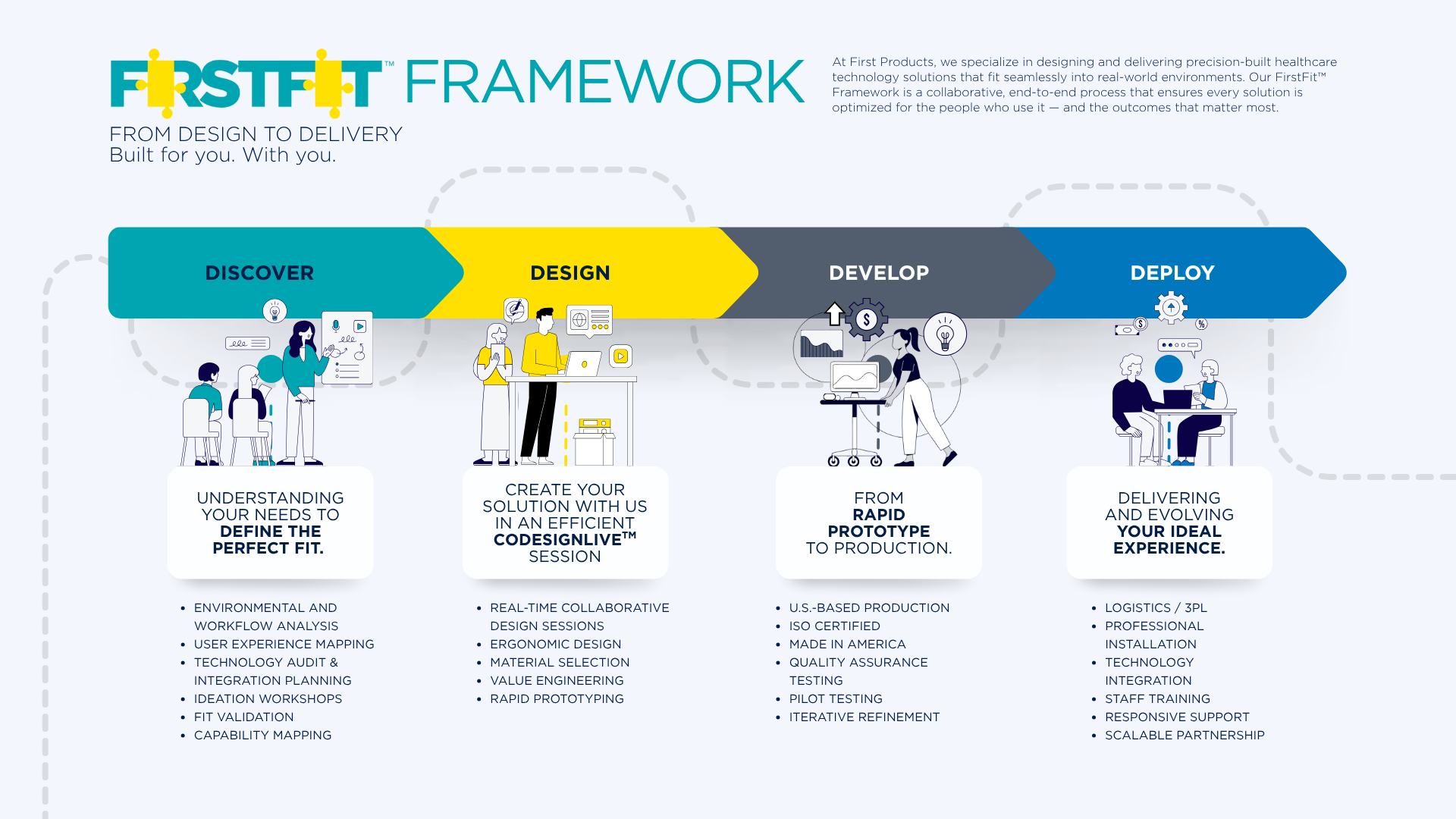
First Products’ FirstFit™ Framework is designed to help healthcare organizations move from concept to deployment more efficiently. The process includes four phases: Define, Design, Develop, and Deploy.
During collaborative design sessions, stakeholders participate together instead of passing feedback through a long chain of emails. Questions can be answered in real time:
- “Can this support our future laptop refresh?”
- “What happens if we switch docking platforms?”
- “Will this interfere with nursing workflows?”
Engineering, IT, operations, and clinical stakeholders can evaluate design decisions together, making it easier to identify issues earlier and build alignment before production begins.
Production then becomes a way to support alignment, not another step that creates more work, delays, and coordination burden. Logistics can also happen alongside production, helping teams prepare for site access, staffing, deployment windows, and white-glove delivery needs.
Built for You, With You
For OEM clients, many things have improved with domestic manufacturing. Supply chains have stabilized. Prototyping cycles have become faster. Collaboration tools have improved. There is less reason for project teams to rely on slow, disconnected review cycles.
That 750-custom-cart deployment mentioned earlier spanned 750+ locations over 1,000+ miles in four months, while a typical delivery could have taken 12 to 18 months.
“The sheer number of decisions that get made by dozens of contributors is a bit like juggling a million batons. The collaborative nature of this process is what resonates time and again, restoring confidence in the timeline and outcomes. That’s why we claim, built for you, with you. And a ‘perfect fit,’ every time.”
— Kim Marone, Vice President of Business Development, First Products
Ready to Create Your Perfect-Fit Solution?
First Products helps OEMs and healthcare organizations design, develop, and deploy custom medical cart solutions built around real workflow needs.
Frequently Asked Questions
How long does a typical telehealth cart deployment take?
Multi-site telehealth cart deployments can take 12 to 18 months when approvals, IT integration scope, and site logistics are handled sequentially. Most delays occur early due to unresolved configuration decisions and staggered stakeholder reviews.
What causes delays in hospital IT equipment rollouts?
Delays usually stem from small, compounding factors, including unresolved component decisions, department-by-department reviews, late prototype feedback, and last-minute scope additions.
How can healthcare IT teams speed up multi-site cart deployments?
Healthcare IT teams can speed up deployment by front-loading decisions, aligning stakeholders earlier, locking in configuration choices before engineering begins, and planning logistics alongside production.
Is manufacturing usually the bottleneck in medical cart deployment timelines?
Not typically, especially with domestic manufacturing partners. For many healthcare organizations, engineering decisions and approval cycles consume more time than the physical build process.
How do you deploy medical carts across multiple locations without disrupting workflows?
Multi-site deployments run smoothest when logistics are planned with the same rigor as equipment design. This includes site-specific delivery windows, coordination with on-site staff, and regular check-ins with IT, shipping, and deployment teams.