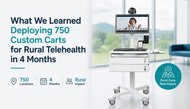
What We Learned Deploying 750 Custom Carts for Rural Telehealth in 4 Months
By First Products on May 11th 2026
For health systems or integrators approaching a first large-scale medical cart deployment, the instinct is to plan thoroughly, lock in a schedule, and execute against it. That discipline matters, but it can also create a false sense of certainty.
In practice, even the most detailed deployment plans don’t unfold exactly as expected. The difference isn’t avoiding surprises; it’s leaving enough flexibility to handle them without losing momentum.
Rural Telehealth Cart Deployment Challenges and Lessons
Based on what we’ve seen in the field, a few patterns consistently shape how these rollouts succeed or stall, such as when a Health Science Center (HSC) affiliated with a major university through a grant-funded behavioral health program sought to implement a state-funded telehealth initiative to serve 750 locations across their state. Here are five insights from the build and subsequent deployment:
-
Rural Healthcare Environments Require Flexible Telehealth Cart Design
Since this wasn’t a traditional hospital deployment, the shift in setting changed everything. The cart had a very different workflow than a traditional care system, moving where care could be accommodated for students of different ages and sizes.
The takeaway: In non-acute environments, care delivery settings are far less controlled, and mobility plus adaptability become core requirements, not simply add-ons.
-
Mobile Telehealth Carts Improved Workflow and Patient Access
In this deployment, the technology was already in place. What was missing was the ability to bring it to the point of need. By moving from a fixed desk setup to a mobile cart, counselors were able to meet students where they were, rather than pulling them into a static space. That’s a subtle but important shift: the cart didn’t just improve efficiency, it also unlocked a more flexible care model.
The takeaway: Hardware decisions can directly influence how care is delivered, not just how efficiently it runs.
-
Why Workflow-Based Medical Cart Design Matters
One of the more telling aspects of this deployment is what didn’t happen:
- No major redesign requests
- No workarounds from users
- No gaps between expectation and reality
That’s not accidental. It reflects a strong alignment with the client in the discovery phase of every project we manage, predetermining the perfect fit solution and the fully defined workflow.
The takeaway: Taking time to precisely match equipment to workflow is just as important as cart complexity.
- Durability and Real-World Mobility Are Easy to Underestimate
While the cart as a technology carrier performed as expected, the school particularly appreciated an often-overlooked feature: durable casters. Grant funding made it critical that the solution be viable across campus, including sidewalks and outdoor paths. Operating in a school environment introduced different durability considerations than a hospital setting.
The takeaway: For OEMs and integrators, this is a reminder about extending consistent performance across unpredictable environments.
- Operational Risks Can Delay Large Healthcare Deployments
Despite a largely seamless deployment, unforeseen delays still occurred that had nothing to do with the carts or technology. Staff availability, travel disruptions, and scheduling conflicts introduced variability into the rollout. This underscores the importance of building flexibility into timelines and maintaining consistent communication rhythms like regular check-ins before and during rollout.
The takeaway: Even when the solution is right, execution can still be impacted by human and logistical factors.
This project reinforced the reality that telehealth is meaningfully expanding access to behavioral and physical healthcare in non-conventional settings, such as schools and community hubs. In this project, the counselors were able to use the carts exactly as intended, taking them out of their offices to more private, secure, and flexible areas for students.
Why the Deployment Details Matter
Taken together, these lessons point to the critical role of deployment in any custom build or equipment installation. Planning projects as operational rollouts helps ensure that the technology and infrastructure fully align with delivery and workflow integration. For the HSC, deployment requirements were as critical as the design and mobility of the solution:
- Tight and very specific timeline within four months to meet IT timelines for integration
- Roll out of 750 mobile telehealth solutions to over 750 locations (across 1000 plus miles)
- White glove delivery, unpacking solution for rapid integration
- Packing material removal and recycling
For clients, this flexibility built into both the plan and the timeline allowed them to absorb the unexpected without losing momentum. Ultimately, once a deployment strategy is validated and pressure-tested, a scaling path is clearly defined for future deployments.
What this Means for CIOs and Integrators
Deployment strategy isn’t just a logistical consideration. To quickly and effectively bring new capabilities to the point of care, the best approach is to keep it actionable, tailored, and scalable:
- Audit infrastructure early
- Map workflow and user behavior
- Pressure-test workflows before scaling
- Expect iteration and phase deployments intentionally
Kim Marone, First Product’s Vice President of Business Development, recalls that it was an almost flawless, seamless delivery from start to finish.
“Reliable freight partners and a solid production plan with weekly check-ins during deployment were key to the success of the project. We never overestimate the ability to maintain a rigid schedule without issues, but collaborative, thorough planning helps us meet even the most challenging customer objectives. All the little details that mean the most to the stakeholders' success.”
Timelines can and will break down in the real world, where clinical workflows, infrastructure constraints, and day-to-day variability all come into play. The teams that navigate deployments most effectively aren’t the ones with the most precise plans; they’re the ones that build in flexibility from the start.
Looking Forward
Rural areas need access to behavioral and physical healthcare, and it doesn’t need to be ad hoc. However, when considering the biggest gaps between current solutions and what rural providers actually need, cost remains a factor. Families who struggle with expenses will neglect the need to seek behavioral or physical healthcare. With grant-funded programs, costs are removed, and outcomes are more successful. Telehealth is changing that for every community being served, making reliable, sophisticated, and functional care a reality.
“Connectivity also plays its part, and some travel will still be expected, even if it is to a school or public library,” said Kim, reflecting on how effective patient care relies on the full picture of the patient. “Integration across platforms, providers, and care plans will continue to help shape the outcome of the patient's future.”
True success is ultimately measured by outcomes. “There are many things to learn from complex deployments like this one. You can analyze everything on the back end, but nothing compares to the actual happiness that is expressed by those that this solution is serving,” said Kim. “The counselors were able to use the carts exactly as intended, adding necessary mobility to their workflows and student needs.”
Contact us if you’re ready to create your ‘perfect fit’ solution.