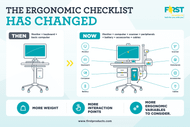
Medical Cart Ergonomics: Key Things to Know for Safer Clinical Workflows
By First Products on Feb 14th 2023
ARTICLE UPDATED: October 6th, 2026
October is National Ergonomics Month, a good time to look at the equipment your clinical teams push, lift, and work at every shift. The guidance below applies all year.
What's in This Article
- Why Medical Cart Ergonomics Matters
- Comfort and Control: Handles and Brakes
- Height Adjustment and Working Posture
- Maneuverability: Casters and Stability
- Organization and Workspace Design
- Using National Ergonomics Month to Review Your Fleet
- Build a Cart That Fits Your Workflow
- Frequently Asked Questions
Why Medical Cart Ergonomics Matters
Healthcare workers face a high risk of musculoskeletal injuries from repetitive pushing, reaching, bending, and standing. Much of that strain comes from everyday equipment, and medical carts are among the most-used pieces of equipment in any facility. A cart that's hard to steer, set at the wrong height, or poorly organized adds strain to every patient interaction.
Ergonomic medical carts help reduce that strain, support better posture, and let clinicians focus on patients instead of fighting their equipment. As you evaluate carts for your hospital, clinic, or long-term care facility, here are the key things to know about medical cart ergonomics.
Comfort and Control: Handles and Brakes
A low-quality cart can feel like it has a mind of its own. If it drifts or slips away from the user, it can damage nearby equipment or cause an injury. The best cart for any medical facility is a safe one, and safety starts with control.
Look for a Natural-Grip Handle
A well-designed handle fits comfortably in the hand. It shouldn't be too thin or too stiff. Angled or wraparound handles let users push from a neutral wrist position and grab the cart quickly to keep it from rolling away or tipping. Handle design is also a good indicator of overall stability: if a cart is hard to hold onto, it's usually hard to control.
Choose Locking Casters
Not every cart has brakes, but locking casters are essential when parking a cart in an exam room, at the bedside, or in a storage area. Brakes keep the workstation steady while clinicians type, scan, or chart.
Height Adjustment and Working Posture
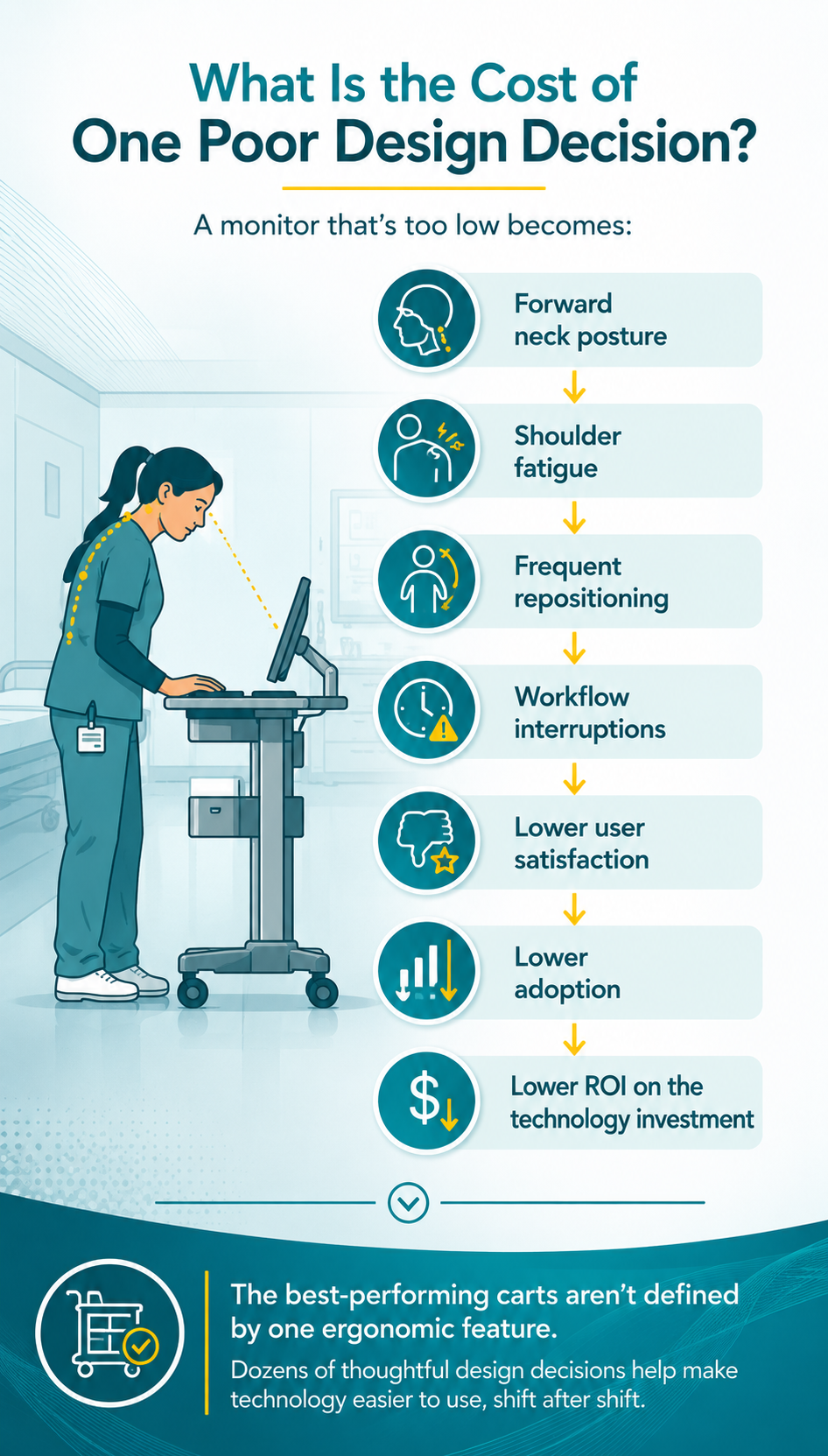
Clinicians come in all heights, and many tasks switch between sitting and standing. A fixed-height cart forces some users to hunch or reach. Look for height-adjustable work surfaces and monitor mounts so each user can keep the screen near eye level and the keyboard at elbow height. Smooth, easy-to-use adjustment matters too, because staff won't adjust a cart that's difficult to change.
Explore height-adjustable options for monitor and panel PC carts, medical laptop carts, and medical tablet carts.
Maneuverability: Casters and Stability
Maneuverability directly affects how much force staff use every time they move a cart. Carts without swivel casters are hard to steer, especially through tight patient rooms, doorways, and elevators. Swivel casters make it easier to move heavy or bulky loads and reduce the twisting and pulling that can lead to injury.
Caster quality matters as well. When you move longer or heavier equipment, you'll sometimes cross thresholds or uneven flooring. Quality casters and a low, well-balanced base help the cart roll smoothly and stay stable. A cart should never be a struggle to move. Make sure your teams have carts that roll easily, load easily, and stay put when parked.
Organization and Workspace Design
Good organization is another key part of medical cart ergonomics. When supplies, devices, and technology are within easy reach, staff spend less time bending, stretching, and searching.
- Shelves and storage above floor level reduce bending to reach supplies.
- Dedicated space for devices such as tablets, scanners, and telemonitoring equipment keeps the work surface clear.
- Integrated cable management reduces trip hazards and makes carts easier to clean.
- Built-in onboard power keeps devices charged so staff don't have to search for outlets.
Choose carts that make transport, organization, and comfort easy. Workers appreciate tablet carts on wheels and mobile workstations that put them in control. First Healthcare Products offers a full line of medical carts, mounts, and mobile desks designed to make work easier.
Using National Ergonomics Month to Review Your Fleet
National Ergonomics Month, held each October, is a natural checkpoint for reviewing the equipment your teams use daily. A quick review can reveal problems that are easy to fix:
- Ask frontline staff which carts are hardest to push, adjust, or park.
- Check casters and brakes for wear, sticking, or missing locks.
- Test height adjustment on every cart model to confirm it works smoothly for both shorter and taller users.
- Look at what's on each cart to see if devices, supplies, and cables are organized or crowded.
- Plan replacements and upgrades for carts that no longer meet your teams' needs.
Whether it's October or any other month, a regular ergonomic review helps protect your staff and keeps workflows running smoothly in acute care and hospitals, long-term care, and dialysis clinics.
Build a Cart That Fits Your Workflow
Off-the-shelf carts don't always match the way your teams work. The FirstFit Framework is our collaborative process for designing healthcare carts and workstations around your specific workflows, in four phases: Discover, Design, Develop, and Deploy. Our team works with yours to build ergonomics into every detail, from handle height to device placement.
Ready to improve ergonomics across your facility? Explore the FirstFit Framework or start your project today. You can also download the FirstFit Project Planning Guide or request a quote.

Frequently Asked Questions
What makes a medical cart ergonomic?
An ergonomic medical cart has a comfortable, natural-grip handle, height-adjustable work surfaces and monitor mounts, smooth-rolling swivel casters with locking brakes, and organized storage that keeps supplies and devices within easy reach. Together, these features reduce strain from pushing, reaching, and bending.
When is National Ergonomics Month?
National Ergonomics Month is observed every October. It's a good time for healthcare organizations to review their carts, workstations, and other equipment for ergonomic problems.
Why are locking casters important on medical carts?
Locking casters keep a cart from rolling while clinicians are using it at the bedside, in an exam room, or in storage. This prevents accidental collisions, protects nearby equipment, and gives staff a stable surface for charting and device use.
Why does height adjustment matter on a medical cart?
Height adjustment lets each user set the keyboard near elbow height and the screen near eye level, whether sitting or standing. This helps prevent neck, shoulder, and back strain, especially on carts shared across shifts by staff of different heights.
Can medical carts be customized for ergonomics?
Yes. Through the FirstFit Framework, First Healthcare Products works with healthcare organizations to design custom carts and workstations, including handle placement, device mounting, storage, and power, to fit specific clinical workflows.