Healthcare Technology Company Case Study: Wheels of Innovation: Co-Developing a Purpose-Built Medical Cart for AI-Enabled Remote Monitoring
By First Products on Jan 6th 2026
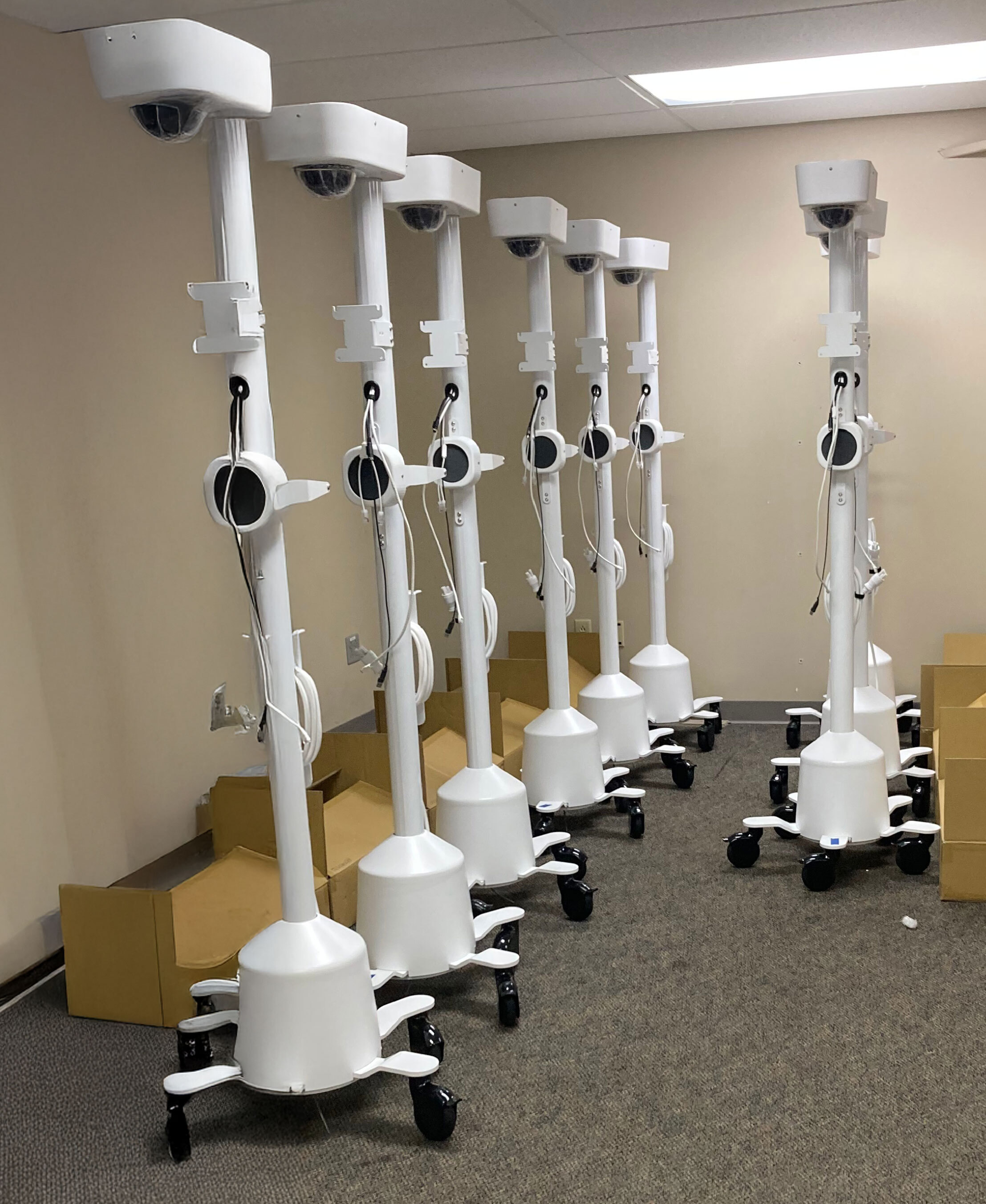
A healthcare technology company developing an advanced remote monitoring solution needed more than an off-the-shelf medical cart. Its platform required cameras, computing equipment, sensors, real-time location technology, audio and video systems, and supporting electronics to function together on a secure mobile platform built for demanding healthcare environments.
The company was also experiencing challenges with its existing medical cart supplier and needed a manufacturing partner capable of moving quickly from concept and evaluation units to scalable production.
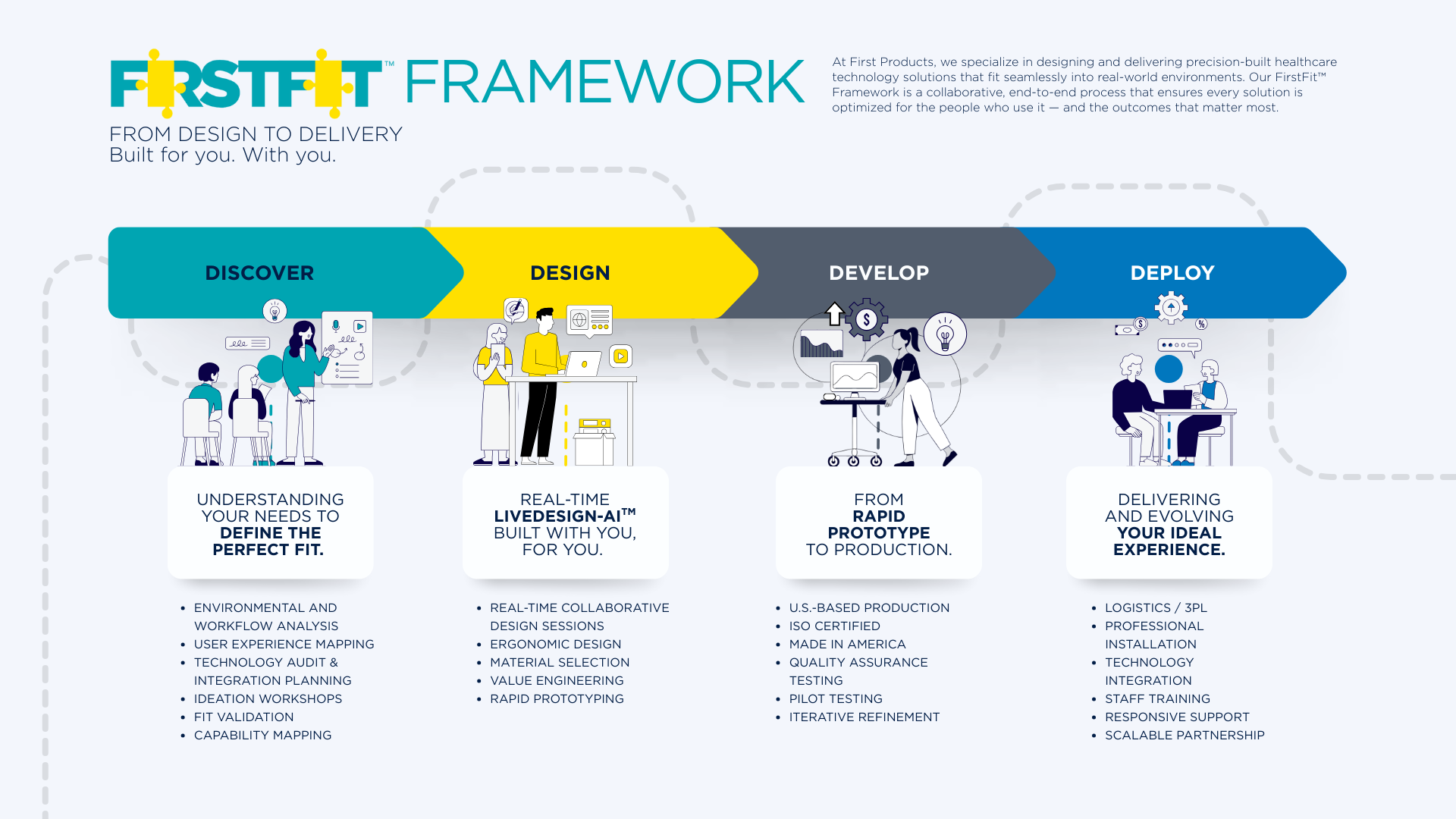
After meeting First Products at a HIMSS healthcare technology event, the company engaged First Products' Perfect Fit custom medical cart development process to engineer a purpose-built mobile solution around its technology.
Case Study at a Glance
Challenge: Integrate a complex remote patient monitoring technology ecosystem into a secure, rugged mobile platform while improving prototype and production responsiveness.
Solution: First Products collaborated with the healthcare technology company to design, engineer, prototype, test, and manufacture a custom medical cart with integrated electronics, advanced cable management, and device-specific mounting.
Result: The program progressed from evaluation units to production of hundreds of fully configured carts with installed hardware, software, and accessories, supported by logistics and deployment services.
The Challenge: Integrating Complex Healthcare Technology Into One Mobile Platform
The healthcare technology company needed a technically complex medical cart capable of supporting multiple electronic systems and mounting applications within a single mobile platform.
The technology ecosystem included requirements for:
- Multi-sensor networks
- Real-time location systems
- Voice-activated services
- Video conferencing
- Computing equipment
- Cameras and supporting electronics
- Secure device mounting
- Advanced cable management
The company also wanted a manufacturing partner that could collaborate closely throughout development, support an iterative prototype process, and provide the manufacturing and logistical capabilities needed for a larger deployment.
“We understand when customers come looking for a different manufacturing model. It’s easy to get bogged down in prototyping and feel like time is being lost. We’ve created a different approach—fast-turnaround evaluation units where the client is intrinsically involved from day one as we build the solution together.”
— Paul Smith, CEO, First Products
A Collaborative Custom Medical Cart Development Process
Development began with First Products' Perfect Fit process. The healthcare technology team worked directly with First Products to define component specifications, deployment environments, technology requirements, ergonomic considerations, and integration challenges.
Rather than designing the cart independently and presenting a finished concept, the teams worked collaboratively through the development process.
First Products' design and engineering team created initial concepts for review and refined the system as additional technical requirements were identified.
This collaborative process allowed the customer to evaluate design decisions early while First Products considered manufacturability, component integration, serviceability, cable routing, security, and future production requirements.
Engineering Requirements for the Remote Monitoring Cart
The custom medical cart needed to support a demanding combination of healthcare technology while remaining mobile, durable, secure, and practical for healthcare environments.
Key design requirements included:
- Mounting for a PTZ camera
- Integration of an all-in-one computer
- Secure mounting for a speakerphone and supporting electronics
- Advanced internal cable management
- Rugged steel and aluminum construction
- Protection of sensitive electronic components
- High-level component security
- Engineering for demanding clinical and medical surge environments
Because the carts could be deployed in environments with significant public interaction, the customer placed particular emphasis on durability and equipment security.
Designing the Medical Cart Around the Technology
Rather than forcing the customer's equipment onto a standard cart configuration, First Products engineered the mobile platform around the technology.
The design included custom structural components, ergonomic considerations, device-specific mounting, aesthetics, and a cable-management system designed to organize and protect wiring throughout the cart.
“We designed it so you don’t see the cables at all. Everything is safely organized and secured to prevent damage. Not all manufacturers offer that.”
— John Henry, Senior Engineer, First Products
Cable management was especially important because the platform contained multiple connected technologies. Keeping cables secured and protected helped improve the appearance of the cart while reducing exposed wiring around expensive electronics.
From Prototype to Functional Evaluation Units
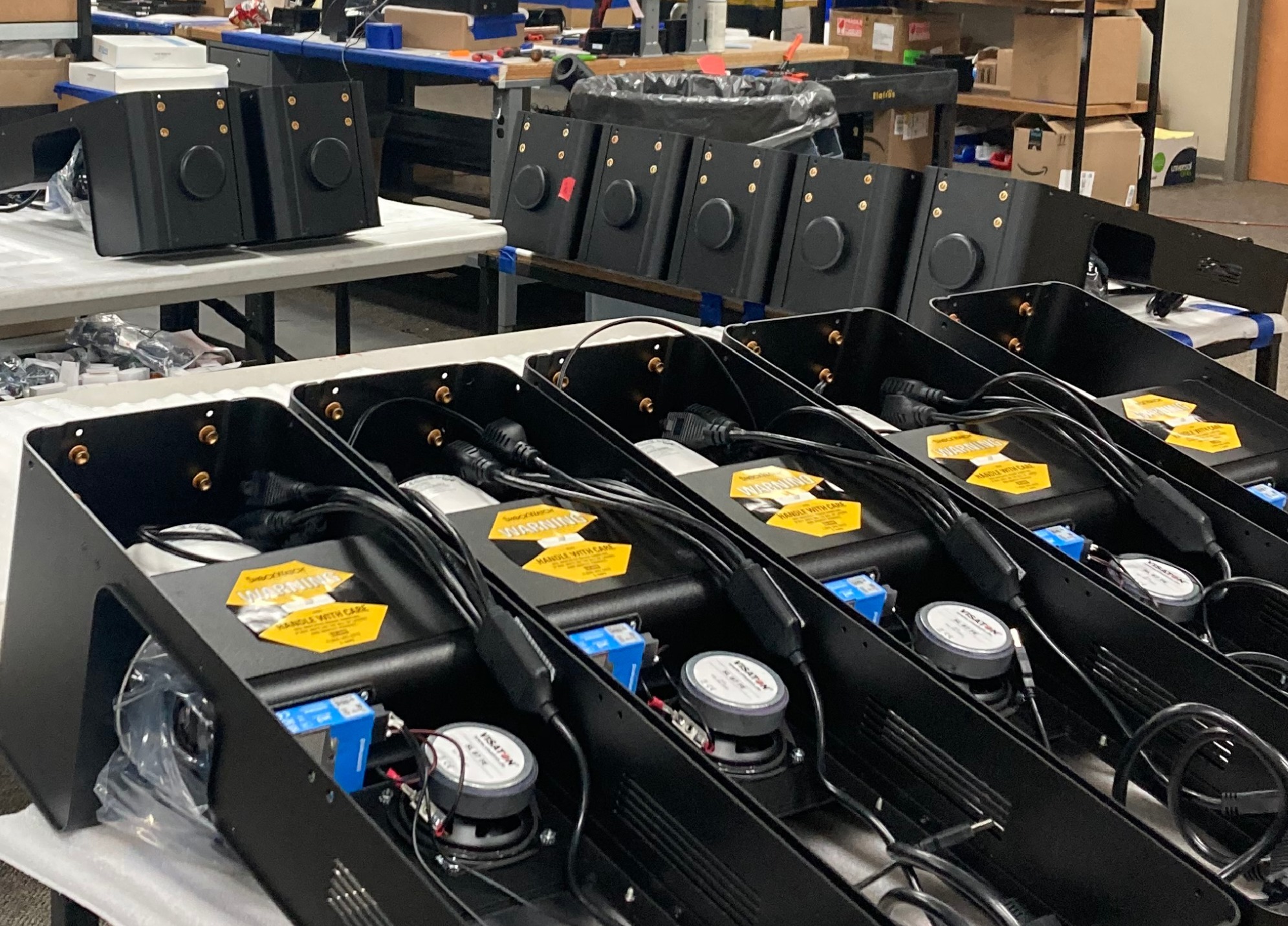
Once the initial design was approved, First Products produced fully functional evaluation units for pilot testing.
Evaluation units allowed the healthcare technology company to deploy the system in realistic environments before committing to full production.
During this stage, the teams could verify:
- Device placement
- Technology integration
- Ergonomics
- Mobility
- Component security
- Cable routing
- Serviceability
- Real-world workflow requirements
Any required refinements could then be incorporated before production scaling.
Scaling From Evaluation Units to Production
After the integrated solution was validated, the program moved into larger-scale manufacturing.
Production ultimately expanded to hundreds of carts. Each cart could be delivered as a fully configured system with installed hardware, software, and accessories.
This approach allowed the healthcare technology company to receive a more complete deployment-ready solution rather than coordinating multiple vendors to assemble components after the cart arrived.
Supporting Component Lifecycle Management
Healthcare technology platforms can evolve quickly as computers, displays, cameras, sensors, and other electronic components change.
First Products works directly with component manufacturers and monitors OEM component lifecycles so potential changes can be identified and addressed before they disrupt production.
When a component changes or reaches end of life, the engineering team can evaluate how that change affects mounting, connectivity, power requirements, cable routing, and the overall medical cart design.
This proactive approach can help healthcare technology companies maintain continuity as their platforms evolve.
Logistics and Deployment Support
The relationship extended beyond product engineering and manufacturing.
First Products also supported logistics coordination, inventory storage, freight management, and deployment planning.
White-glove delivery services allowed completed carts to arrive at healthcare deployment locations unpacked, inspected, and ready for use.
For the end user, implementation could be as simple as positioning the cart, connecting it to power, and connecting the technology to the appropriate network.
The Result: A Purpose-Built Platform Ready for Healthcare Deployment
What began as a discussion at a healthcare technology event developed into a long-term manufacturing relationship supporting a complex remote monitoring solution.
First Products helped the customer move from concept and evaluation units to scalable production while supporting:
- Complex technology integration
- Custom medical cart engineering
- Rapid prototype and evaluation units
- Production manufacturing
- Component lifecycle monitoring
- Inventory management
- Freight coordination
- Deployment-ready delivery
What This Case Study Demonstrates for Healthcare OEMs
For healthcare OEMs and technology companies, the physical platform supporting a technology solution can be just as important as the technology itself.
A manufacturing partner must be able to work within product specifications while also considering manufacturability, integration, quality, logistics, component availability, and future product changes.
This project demonstrates several capabilities that can be important when evaluating an OEM medical cart manufacturing partner:
- Collaborative engineering: Design teams work directly with customers throughout development.
- Technology integration: Multiple medical, computing, video, sensing, and communication technologies can be incorporated into one mobile platform.
- Prototype-to-production support: Evaluation units allow customers to validate the solution before scaling production.
- Manufacturing scalability: Designs can move from custom development into repeatable production.
- Lifecycle support: Component changes can be evaluated proactively as technology platforms evolve.
- Deployment logistics: Inventory, freight, configuration, and delivery services can support large-scale deployments.
Developing a Healthcare Technology Platform?
If your technology requires a custom cart, mobile workstation, device mounting platform, or integrated OEM manufacturing solution, First Products can help take your specification from design review through production.
Frequently Asked Questions
What is a custom medical cart?
A custom medical cart is a mobile platform engineered around the specific equipment, technology, workflow, mounting, power, security, and ergonomic requirements of a healthcare application rather than relying solely on a standard cart configuration.
Can First Products integrate technology into a medical cart?
Yes. First Products develops custom medical cart solutions that can incorporate computers, displays, cameras, sensors, communication equipment, accessories, mounting systems, electronics, and cable-management requirements.
Can a custom medical cart be prototyped before production?
Yes. First Products can develop functional evaluation units that allow customers to test the integrated solution and make refinements before moving into larger-scale production.
Does First Products support OEM medical cart manufacturing?
Yes. First Products supports OEM and healthcare technology companies with design collaboration, engineering, prototyping, manufacturing, technology integration, component lifecycle support, logistics, and deployment services.
Can First Products support production after the original components change?
First Products monitors component requirements and can evaluate design updates when computers, displays, cameras, sensors, or other integrated technology changes during the product lifecycle.
Have a custom project in mind? Contact First Products to discuss your application.