
The Hidden Cost of a Cart That Doesn’t Fit: Workflow, Adoption, and ROI
By First Products on Jun 2nd 2026
In custom medical cart implementations, every aspect of the project is planned and budgeted appropriately to ensure the solution performs successfully in intended care settings. But what happens to the budget when last-minute workflow requirements change the plan? Healthcare IT leaders have to deal with a workflow mismatch, and more than just the budget line is impacted; adoption and project return on investment (ROI) are also at stake.
Medical cart ROI begins with staying on budget, but continues with the on-floor realities of medical cart deployments. Is the cart being used as specified? Are adoption rates consistent with expectations for team and mobile medical cart workflow efficiency? These are real concerns. We’ll explore three hidden cost drivers of a poor-fit cart in more detail: workflow disruption, adoption failure, and implementation burden. Budgeting smarter from the start begins with understanding the hidden costs.
The Purchase Price Is the Wrong Number to Watch
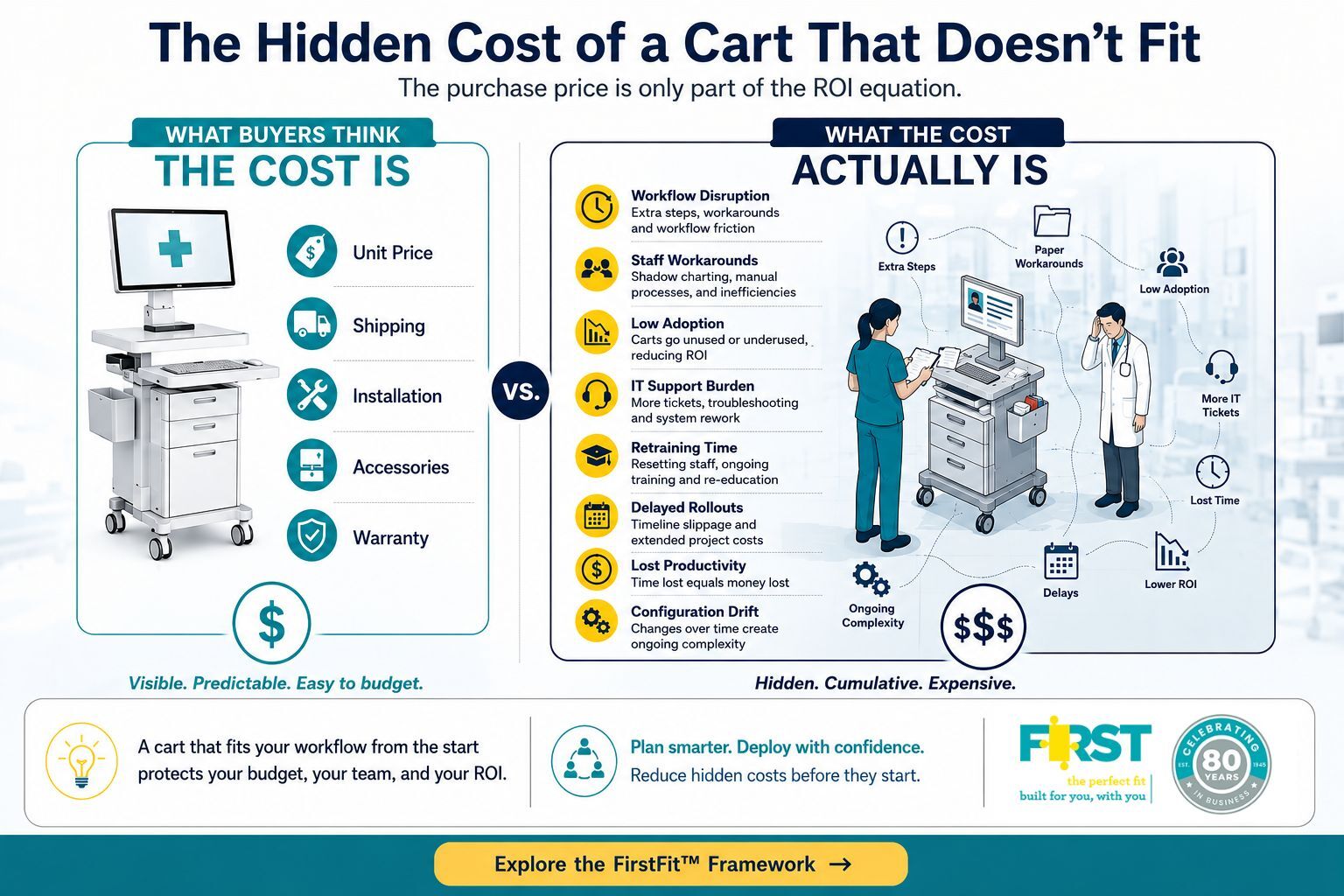
Let’s start with the total cost of a cart. Initial purchase price is one aspect, as are the myriad of healthcare cart deployment costs required to acquire, operate, and maintain a cart throughout its lifecycle. Total cost also factors in:
- Customization requirements
- Power Integrations
- Technology integrations
- Shipping and installation
- Ongoing service and support
- Replacement parts
Workflow efficiency affects the total cost of ownership. Does the cart meet expectations for reducing downtime or supporting caregiver productivity? Even cart scalability that adapts to changing clinical needs delivers greater long-term value.
Visible features, dimensions, pricing, and deployment timelines are critical to evaluation, but what is not getting factored in? Proper fit of the solution to the workflow, staff, and integration environment is the real variable. Workflow disruption, adoption failure, and implementation burden can and do erode expected value.
We’ll explore these hidden costs next.
Hidden Cost #1: Workflow Disruption During Rollout
Imagine this happening after the cart deployment. Nurses realize there isn't enough room to comfortably manage medication administration and the tasks that accompany it, such as bedside scanning and documentation. Quickly realizing that taking notes on paper and entering them later saves time, a shadow charting risk develops, with each nurse adapting a workaround that suits them.
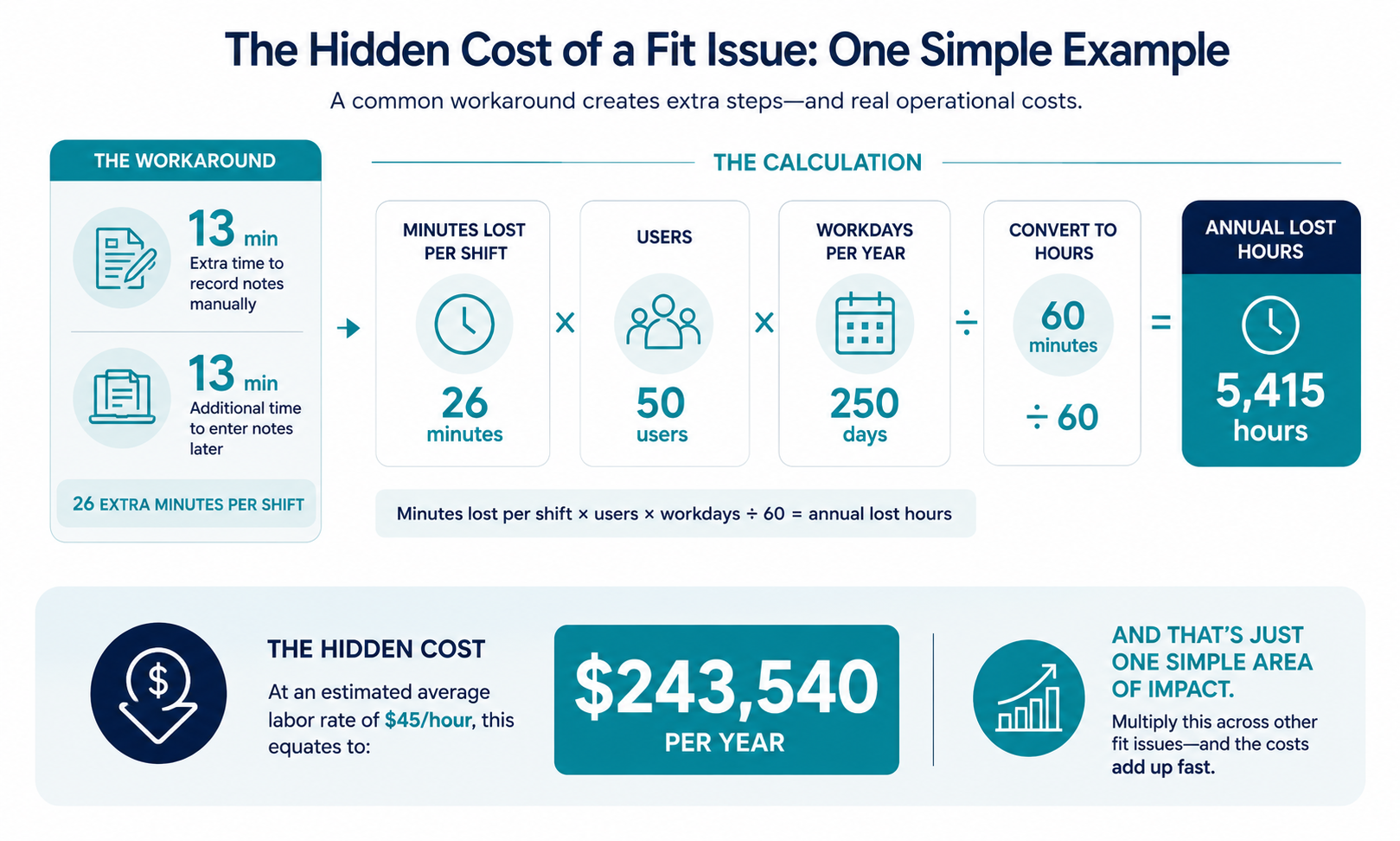
To estimate the hidden cost of a fit issue like this, let’s use a typical workaround to identify operational costs. In this scenario, it takes 13 extra minutes per healthcare staff member per shift to record the notes manually, and an additional 13 minutes to enter them later. Now apply this to 50 users, 250 workdays per year.
The calculation looks like this: Minutes lost per shift × users × workdays ÷ 60 = annual lost hours.
In this scenario, that’s roughly 5415 additional labor hours annually. With an estimated average labor rate of $45/hour, this equates to $243,540/year in hidden operational costs. And that’s just one simple area of impact.
Workflow disruptions caused by a poor cart fit add up. Carts that fit the workflow from the start are game changers for cart investment ROI. This is one reason why making your medical cart vendor your first callwill positively impact total cost outcomes.
Hidden Cost #2: Poor Adoption & What It Actually Costs
A lot depends on clinicians using carts and equipment as planned in their care workflows. Medical equipment and cart adoption depend heavily on the alignment of equipment with real-world use. It is also widely understood that when mobile workstations are difficult to maneuver, underpowered, or poorly aligned, adoption rates suffer as clinicians resort to workarounds.
Here’s one example that you may recognize. A healthcare organization standardizes a cart configuration that meets technical requirements but fails to account for the needs of different clinical departments. Issues start to develop instantly. For example:
- Emergency staff find the carts too cumbersome for fast-paced care.
- Inpatient teams struggle with battery life and storage limitations.
When cart adoption becomes inconsistent across departments, a whole host of issues can emerge, such as alternative equipment reappearing on the floor or an increase in IT support requests.
The hidden costs appear in the erosion of standardization, which involves retraining efforts or new processes to address technical considerations, such as battery life. Can issues such as these be caught upstream before deployment? Many can. Thorough evaluations in the early phases of a custom cart integration, involving clinical staff and workflow analysis, are critical, well before any cart hits the floor, wherever the care is intended.

First Products approaches custom cart design differently to deliver the perfect cart fit for any care environment. Built for you and with you.
Hidden Cost #3: Implementation Risk and IT Burden
Now, let’s examine the IT side of the hidden-cost dilemma. A healthcare organization selects a cart based primarily on specifications and price. Assumptions were made about how the technology would perform, but never validated. This is a common aspect of cart choice, such as whether the battery system will support the intended shift length, or if IT can support charging, imaging, and device management with existing resources.
Then the rollout begins, and IT teams have to scramble when the cable routing doesn't accommodate selected peripherals, as one example. What was expected to be a straightforward deployment is now delaying implementation and adoption timelines, and diverting the organization’s skilled technical resources from higher-value initiatives.
Often, as a result, IT teams spend many weeks troubleshooting problems that could have been addressed during the evaluation stage of the cart choice such as:
- Eliminating device compatibility surprises, such as equipment that doesn't mount as expected.
- Addressing power and battery issues around runtime, battery management, or insufficient charging infrastructure.
- Resolving cable management problems upfront to eliminate avoidable support tickets.
- Containing configuration drift when departments request modifications after deployment.
When the right questions are asked upfront, unresolved assumptions don’t have to surface during the rollout.
What a Better-Fit Process Actually Looks Like
These are just three hidden costs that are driving healthcare organizations to increasingly value partners who can support the process from design through deployment. Everyone intrinsically understands the importance of identifying potential red flags, but whether it is applied in practice is another issue.
No cart deployment is completely free of challenges. It is easy to fall into the “one-size-should-fit-all” theory—a trap to avoid at all costs. And frankly, it’s impossible to promise to eliminate every risk. The goal is to identify and address as many variables as possible before deployment.
This is the power of a systematic approach to prevent wrong-fit medical cart problems. All necessary components and variables are evaluated up front during the discovery stage, using a methodology that uncovers and reduces risk.
Then, as the process unfolds, design considerations are explored, prototypes validate the assumptions, workflows are tested, user feedback is integrated, and the solution is modified well before the actual carts leave the manufacturing floor, get deployed out the door, and are supported long-term.
A better-fit process combines the organization’s expertise with a collaborative manufacturing partner to balance the process. At First Products, we call this better-fit process our FirstFit™ Framework, encompassing four phases: Discovery, Design, Develop, and Deploy. We believe in delivering solutions that actually work as envisioned.
The ROI Equation: Fit First, Then Price
CIOs, IT Directors, IT Project Managers, and Clinical Informatics leaders responsible for mobile workflow infrastructure know that a poorly specified cart costs far more than a well-designed one. Exploring wrong-fit cart costs reveals a Pandora’s box of revenue loss that emerges when carts don’t align, a scenario every healthcare leader strives to avoid.
A cart purchase decision always has so many moving parts; it's imperative to move the discussion away from simply price per unit towards the total cost of fit to the workflow, medical cart adoption rate, and implementation success.
Friction is inevitable, but when it occurs at the right point in a proven process, it strengthens outcomes, intentionally addressing issues before they become problems.
If you’re planning a cart deployment in the next 12 months, schedule a FirstFit Discovery Session. We help you pressure-test workflow, integration, and deployment readiness before production begins.