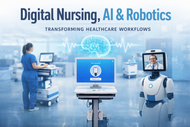
Digital Nursing 2.0: AI, Robotics, & Infrastructure Powering the Next Era of Care
By First Products on Mar 27th 2026
Digital Nursing, AI, and Robotics: How Intelligent Workflows Are Reshaping Care Delivery
Digital nursing is evolving beyond standalone tools into connected ecosystems that combine AI, robotics, telehealth, and infrastructure to support safer, more sustainable nursing workflows.
Digital nursing is growing as healthcare technology advances beyond isolated tools and toward intelligent, connected ecosystems. AI pilot programs are moving into operational deployment. Healthcare robotics is expanding beyond surgery into bedside support and logistics. And as automation investments become reality, hospitals are evaluating the software, workflows, and infrastructure readiness that will shape nursing for years to come.
What technology programs are hospitals adopting today? We’ve been talking with clients about their experience with AI and robotics in nursing workflows to better understand both their successes and pain points. Here are some of the themes emerging from those conversations.
The Rise of Robotics in Nursing Applications
Robotics in healthcare is no longer limited to the operating room. While systems like the da Vinci Surgical System helped define early adoption, today’s expansion is increasingly focused on nursing-adjacent workflows, patient support, and operational efficiency.
Examples include:
- Autonomous Delivery Robots: Designed to reduce physical fatigue and unnecessary walking, these robots can transport medications, linens, lab samples, and other supplies. They can also reduce non-clinical trips and help minimize exposure risk in isolation units.
- Robotic Lifting and Mobility Assistance: Nurse injury remains a major concern, especially musculoskeletal strain and back pain. Robotic lifting technology can help support safer patient handling and reduce physical strain on clinical staff.
- Telepresence Robots: These systems enable virtual rounding, extend specialist access to rural facilities, and support surge staffing models during seasonal spikes, outbreaks, or natural disasters.
- Robotic Environmental Disinfection: Driven by infection control priorities and the growth of virtual care, these technologies are gaining traction for room disinfection and broader infection prevention workflows.
These innovations matter because nursing remains central to care delivery. According to the Bureau of Labor Statistics (BLS), nurses now represent over 50% of the health workforce and are crucial to the entire U.S. healthcare industry. However, since significant nursing shortages persist, robotics is increasingly seen as a force multiplier for nurses.
AI + Robotics + Nursing = Intelligent Workflow Automation
One of the biggest questions hospitals are now asking is this: Are these systems interoperable and infrastructure-ready? That question matters because the real transformation is not happening in one technology category alone. It is happening in the way these systems begin working together as an ecosystem.
Consider this framework:
- AI supports patient deterioration prediction, diagnosis assistance, clinical decision support, documentation automation, administrative workflows, and safety optimization.
- Robotics performs logistical tasks that reduce non-clinical burden on nurses.
- Mobile carts and wall-mounted systems bring data, technology, and medication access closer to the bedside.
- Telehealth extends care delivery beyond facility walls and broadens access to expertise.
Together, these technologies create a more cohesive model for nursing support. This marks a shift from pure efficiency to workflow sustainability, where technology helps reduce burnout, lower friction, and preserve clinical capacity.
Measurable outcomes may include reduced nurse injury claims, faster documentation cycles, lower readmission rates, and improved patient satisfaction.
Infrastructure Makes It All Possible: The Unsung Hero of Digital Nursing
As AI and robotics expand, the physical layer of digital care remains essential. Devices still need power. Equipment still needs to be mounted. Workflows still depend on access, mobility, durability, and integration at the point of care.
That is why infrastructure matters just as much as software. Flexible configurations, modular adaptability, and durable mobile platforms are becoming even more important as healthcare technology environments grow more complex.
The traditional medical cart may begin to look different as new use cases emerge, but the underlying need will remain the same: infrastructure must be rugged, high-performing, and ready to support evolving clinical workflows.
As healthcare moves toward collaborative robotics, AI-powered workflow orchestration, and physical-digital convergence at the bedside, all of that innovation still needs to be housed, mobilized, powered, and made accessible to care teams.
As healthcare leaders ask whether their environments are robotics-ready, they should also ask who can help them get there. A custom manufacturer can be more than a product supplier. The right partner can help explore the vision, operational goals, and practical realities of bringing innovation to the point of care.
Technology Is Accelerating. Transformation Remains Human.
The new realities of digital nursing are not about replacing human judgment. They are about reinforcing it.
At the same time, pain points from technology adoption are evolving. Robots may block hallways in high-traffic units. Nurses may not always be sure when to use a robot versus handling a task directly. AI systems can introduce new layers of alerting that contribute to notification fatigue.
Robotics, AI, and intelligent infrastructure can reduce friction, lower cognitive load, and protect clinical capacity. But the real transformation happens when healthcare organizations treat technology not simply as a deployment, but as a redesign of how work gets done.
That means involving nurses early, building strong onboarding programs, creating feedback loops, and testing workflows before scaling. The hospitals most likely to see strong returns on their investments will not just install smarter systems. They will build cultures that are ready to use them effectively.
Conclusion
Digital nursing is moving toward a future defined by connected systems, intelligent automation, and infrastructure that supports care where it happens. AI, robotics, telehealth, and mobile technology are each important on their own. Their greatest value, however, comes from how they work together to support nurses, strengthen workflows, and improve the sustainability of care delivery.
Source Note
This article is based on internal market observations, client conversations, and the source draft provided by First Products.