Bringing AR/VR Out of the Lab and Into Everyday Healthcare
By First Products on Feb 10th 2026
Don’t be surprised if, at some near date, your doctor presents you with some gloves and smart glasses and says, “Let’s really get to the bottom of what is troubling you.” Virtual stress elimination? That’s the new “reality” of healthcare: Augmented Reality (AR) and Virtual Reality (VR) applications for specialized use in a growing number of hospitals. How fast is this spreading? In one survey, over 75% of healthcare organizations had implemented or intend to implement VR, now that regulatory agencies such as the FDA are clearing AR/VR medical devices for clinical use. These technologies are making a wide range of health experiences feel more real, tangible, and immersive for hospital professionals and patients.
What is AR/VR technology, and how are custom medical cart manufacturers responding to emerging advancements in healthcare? We’ll address this, what’s in it for caregivers and patients in terms of successful outcomes, and how custom cart manufacturers like First are working alongside the innovators to support these immersive technologies.
What Is the Difference Between AR & VR Technology?
If you’ve ever worked in a program like Photoshop, you’ll understand Augmented Reality (AR). The technology “layers” digital images, sounds, and data onto the user's view of the real world (via smartphones or smart glasses). A user’s device camera captures their real-world environment and overlays digital elements onto the live feed, enabling them to interact with both physical surroundings and virtual objects.
Augmented Reality (AR) in healthcare can enhance training, realistic surgical planning, mental health treatment, patient education, and rehabilitation by overlaying digital information (such as 3D anatomy, vital signs, or instructions) onto the real world. This can improve precision for surgeons, engagement for students, and understanding for patients, while also enabling remote collaboration and accurate wound assessment, all in a fully immersive, completely artificial digital environment.
What makes AR/VR effective in healthcare is haptic feedback, which provides realistic tactile sensations such as vibrations, forces, and motion. Users feel virtual objects, textures, impacts, and resistance through devices like gloves, vests, and controllers. As a result, safer, more engaging, and more effective patient care and professional development.
Top AR/VR Applications in Healthcare
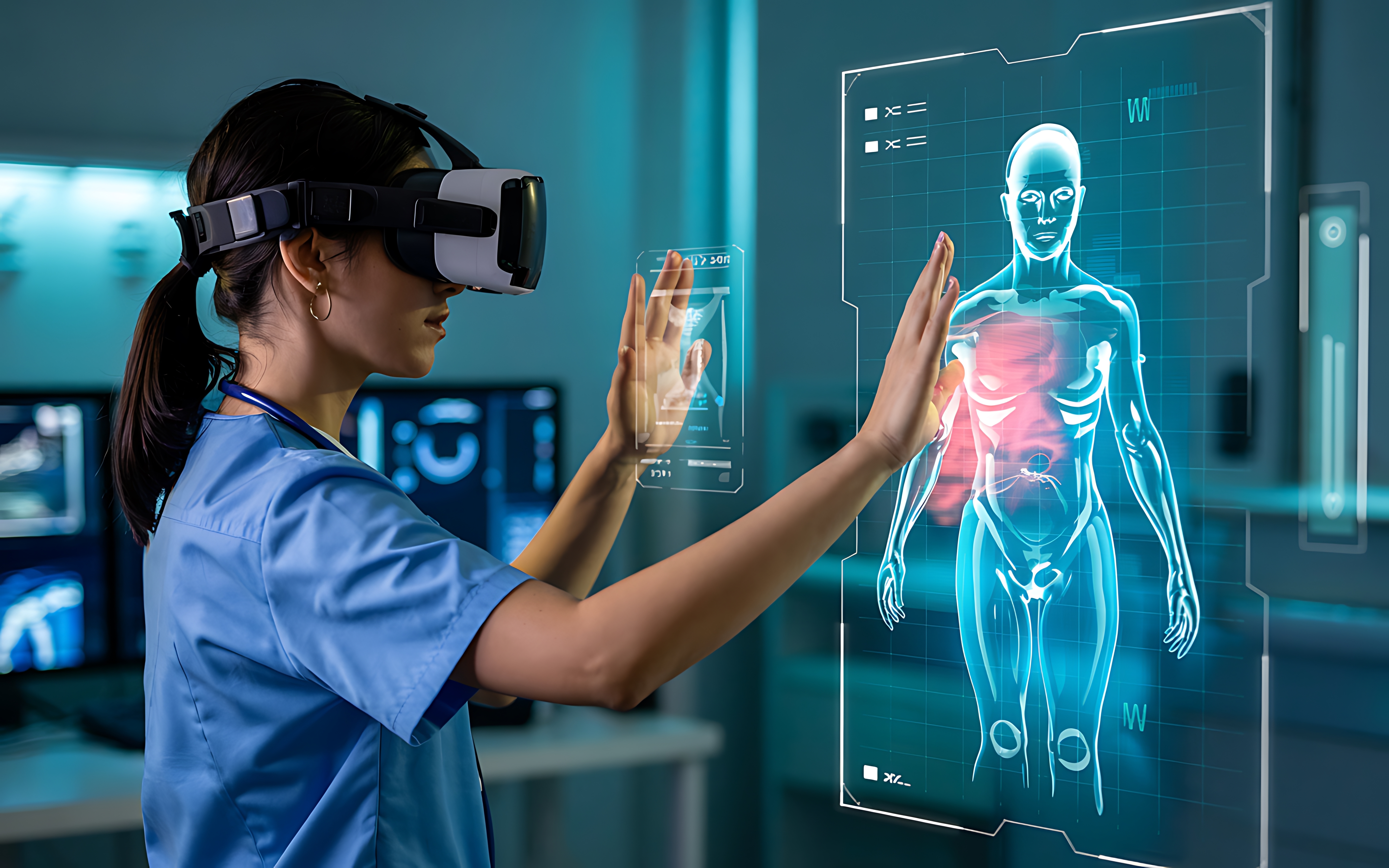
Several applications have emerged as leading candidates for AR/VR adoption in U.S. hospitals. These include medical education and training, advanced surgical navigation, planning, and procedures, and mental healthcare therapeutics. Gamified physical therapy and rehabilitation, enhanced patient education, and expanded telemedicine are also strong growth areas. Here’s a deeper dive into a few of these specialties.
- Medical training and education are used for surgical training simulations or anatomy visualization; for example, students and professionals can examine anatomical structures and disease pathologies through interactive 3D formats.
- Procedures and preoperative planning enhance surgical precision and improve patient outcomes before the actual surgery.
- Remote assistance allows experts to guide on-site surgeons during complex cases through live streaming and AR overlays, enhancing knowledge across multiple physical locations.
- Pain management can reduce a patient’s need for medications and lower stress levels in cardiac rehab.
- Mental healthcare teams employ all-in-one VR devices for innovative therapies like Virtual Reality Exposure Therapy (VRET) to treat debilitating phobias, PTSD, and social anxiety.
These technologies provide safe, engaging environments for therapy, improve understanding of complex conditions, and boost adherence by making treatment more interactive and personalized.
Do AR/VR Applications Help Achieve Intended User Outcomes?
The short answer is yes! AR/VR applications are showing significant promise and growing effectiveness in treating and managing conditions. The broader impact of improving outcomes includes:
- Lowering overall healthcare costs, like reducing medication use, and potentially enabling home-based rehab.
- Addressing care gaps caused by understaffing or burnout, and improving access to specialized care in underserved areas.
- Enhancing medical training for higher satisfaction and improved skills. High adoption in medical training, with studies showing VR improves surgical accuracy (87%) and skill acquisition (NIH).
- Increasing patient engagement, better understanding of complex information, and reduced pain/anxiety during procedures.
In essence, AR/VR offers a novel approach, but wider adoption hinges on overcoming practical implementation barriers, including cost, infrastructure requirements, regulatory constraints, and technical literacy.
Where Custom Medical Cart Manufacturers are Engaging in AR/VR integration
IT integrators can face significant barriers when creating and implementing AR/VR applications in healthcare, including high costs, system integration challenges, data security and regulatory hurdles, and user adoption issues. These challenges are consistent across medical training, procedures, and mental healthcare applications. Custom medical cart manufacturers can support the integration of AR/VR applications by designing specialized, purpose-built carts that securely house, transport, power, and integrate the necessary sophisticated equipment.
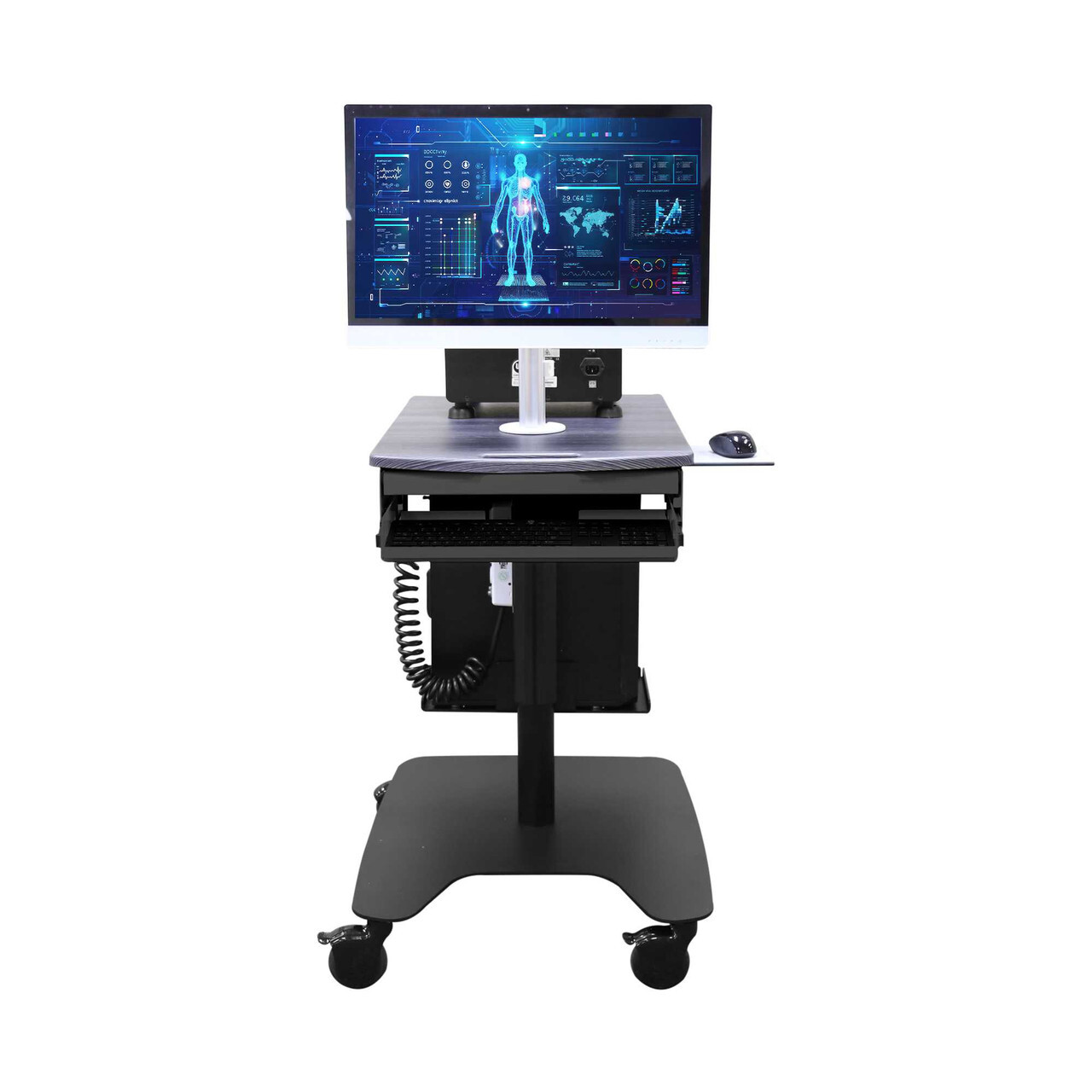
Custom medical cart manufacturers play a vital role in making this kind of VR technology practical, safe, and accessible wherever it is deployed. FIRST’s Virtual Reality Simulation Cart is a purpose-built cart designed with our FirstFit™ Framework to support immersive VR applications in healthcare education, military training, and other areas. It was designed to streamline the secure integration of the VR technology, tailored to the demands of virtual reality simulation.
Here are a few other ways manufacturers are a central part of any solution:
- Secure Integration for Hardware Optimization:
- Custom-fit carts with secure mounting brackets and storage compartments for delicate AR/VR headsets, haptic feedback devices, high-performance computing units, and associated cables, protecting high-value equipment for safe, clinical use.
- Wall-mount high-res Ultra HD or vibrant OLED screens for lifelike visuals, wider fields of view, and reduced screen-door effect. The FIRST TeleView® Wall Mount is an example of a design that holds TV monitors for telemonitoring and telehealth applications.
- Integrated power systems, including swappable batteries, ensure AR/VR devices can be used continuously during training, therapeutic sessions, or procedures.
- Mobility and Ergonomics:
- Offer lightweight or compact frames, 360-degree swiveling casters, ergonomic handles for easy movement from operating rooms to patient rooms or training facilities.
- Adjustability to accommodate a wide range of users across applications to reduce user fatigue and enhance caregiver interactions and access.
- Connectivity, Security, and Safety:
- Carts should support integrated Wi-Fi or wired connections and include lockable compartments to protect valuable hardware and patient data.
- To meet strict medical standards, carts should include features such as easy-to-clean, antimicrobial surfaces for infection control.
- Modularity and Adaptability:
- Modular designs allow healthcare providers to upgrade or swap out equipment easily as new technologies emerge.
- Reliable customization to help healthcare organizations scale as usage and applications increase, from a handful at first to large deployments over time.
By focusing on these specialized requirements, custom medical cart manufacturers can deliver significant added value, moving beyond simple transportation solutions to become integral partners in delivering next-generation healthcare technology.
How First Is Paving the Way
Using a service-driven approach and cutting-edge technologies, First Products can shorten the gap between design and deliverables, mitigating the risks of costly delays from overseas manufacturing while supporting clients’ crucial need for product reliability and compliance.
“We’ve seen the trends for VR, telehealth, and telemonitoring applications continue to scale in the health organizations over the years, along with many new applications like AR/VR," says Paul Smith, CEO, First Products. “It’s an honor to work with clients who are pioneering in the industry, creating and customizing solutions that bring these technologies to the point of care, impacting the quality of education and care for professional staff and patients alike.”
For decades, First Products has proudly offered a full line of robust American-designed, sourced, and manufactured mobile mounting solutions throughout the U.S. and globally.
This foundation makes First a go-to brand in the industry for 100% customizable medical carts and workstations, configured to exact IT requirements for immersive technologies.
We’re showcasing our CODESIGNLIVE Sessions at VIVE and HIMSS. These unique 15-minute meetings illustrate the real power of collaborative, custom design, taking your technology-enabled mobile cart solution from vision to a caregiver powerhouse.